
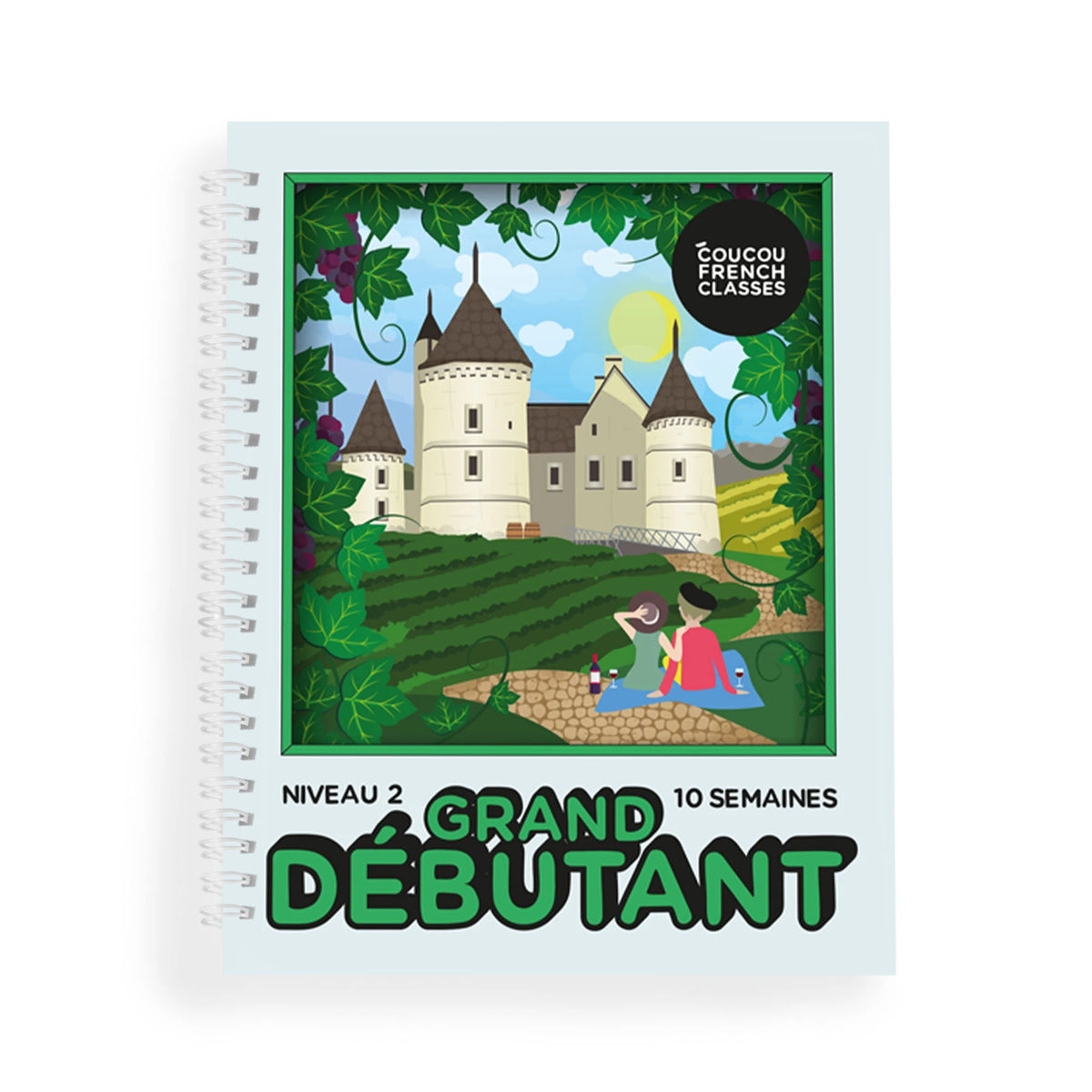
Course Book PDF
Value: $25


SEP 24 - DEC 3
This class expands your control of the present tense and introduces the verb patterns and grammar structures that make everyday French much more flexible.
Level 2 expands your control of the present tense and introduces the verb patterns and grammar structures that make everyday French much more flexible.
You’ll learn three ways to ask a yes-or-no question in French, then add the main question words for “where,” “when,” “why,” “how,” “how much,” “who,” and “what.” That gives you what you need to ask someone else about their life, not just talk about your own.
Pouvoir, vouloir, and devoir cover “can,” “want,” and “have to,” and each one is followed by another verb. You’ll also learn the difference between savoir and connaître, the two French verbs that can both mean “to know.”
This lesson uses prendre, venir, and tenir as models for several irregular verb families. You’ll also learn venir de plus an infinitive, the structure French uses to say that something just happened.
C’est or il est? Both can translate as “it is,” but the choice depends on what comes next. You’ll learn when French uses each one when identifying or describing a person, place, or thing.
This lesson adds the partitive articles du, de la, and des, which French uses when talking about an unspecified amount of something, especially food and drink. You’ll also look at how verbs like “to like” and “to eat” can change the article that follows.
Once you name a quantity, French changes the article that follows: a lot of time, a kilo of apples, a cup of tea. You’ll practice the rule with restaurant vocabulary, so you can use it while ordering and talking about food.
This lesson groups irregular verbs by how they behave, using a handful of model verbs to cover larger families. You’ll work with common verbs like partir (to leave), dormir (to sleep), mettre (to put), attendre (to wait), lire (to read) and écrire (to write).
Reflexive verbs cover a lot of everyday actions, from waking up and getting dressed to hurrying and going to bed. You’ll learn how the structure works, then use it for reciprocal actions too, like meeting each other or getting along.
This lesson goes beyond ne… pas with ways to say “never,” “nothing,” “nobody,” “no longer,” “nowhere,” “only,” and more. You’ll also work with voir and croire and the different French verbs used for ideas like “to think” and “to believe.”
This lesson introduces the passé composé, a past tense used to talk about completed actions. You’ll learn how to build it with avoir and a past participle, then use it to talk about what happened yesterday, last week, or over the weekend.
WHAT STUDENTS ARE SAYING
You’ll have access to make-up videos in your Student Portal. Each video becomes available at the scheduled time of the class you miss and covers the same lesson material, so you can easily catch up and stay on track. Please note that these are archived lesson recordings, not recordings of your specific class.
Because our classes are small, fixed groups, we reserve your spot for the entire course and may not be able to fill it if you drop out. That's why your options for changing your class depend on how far in advance you let us know:
Signature Classes have a capacity of 10–12 students per group, with groups ranging from 4–12 students depending on enrollment.
Keep the momentum going! After finishing your Signature Class, we recommend taking at least 5 Conversation Labs at the level you just completed to practice and solidify what you’ve learned.
Yes! You can choose to pay in installments at checkout.
