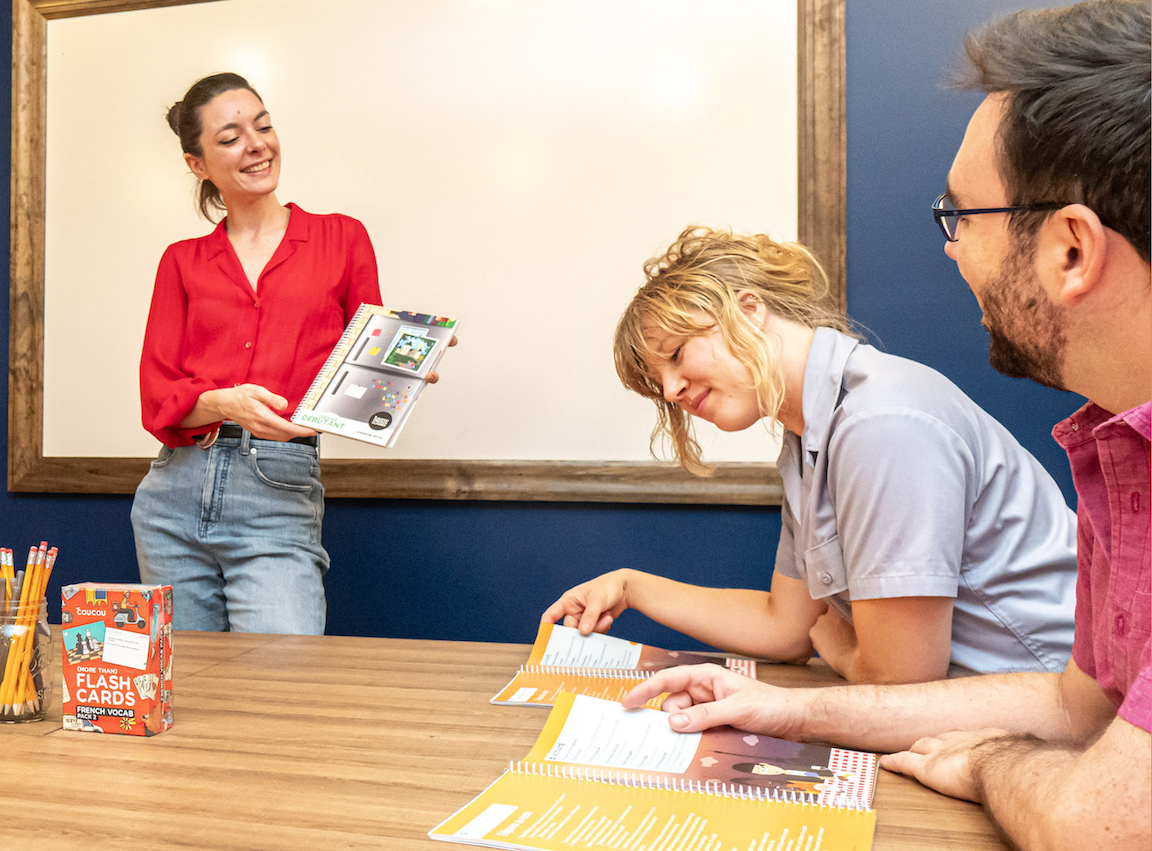
By Léa Perret, CEO of Coucou
There is a piece of feedback we have received at Coucou for as long as I can remember: “I don’t think everyone in my class is the right level.”
Sometimes it comes from a student who feels behind. Sometimes from someone who feels ahead. And I understand both.
Nobody wants to spend an entire class feeling completely lost, and nobody wants to feel like they are not being challenged. Levels matter. Placement matters. But after fifteen years of teaching French, I also think there is something deeper behind this particular frustration. We spend a lot of energy figuring out where we stand in relation to everyone else. Is she better than me? Am I better than him? Why can they speak so easily? Why doesn’t that person know this yet? And while we are busy measuring everyone else’s French, we often pay much less attention to the only progress that really matters: our own.
Your French doesn’t have one level
We tend to talk about language levels as if French were a video game. You finish Level 1. Ding! You unlock Level 2. Finish Level 2. Congratulations, you are now officially 37% French.
That is not how a language works! You can have excellent grammar and be terrified of speaking. You can speak confidently while making mistakes constantly. You can understand a French movie and then freeze when a waiter asks you a question you weren’t expecting. You can know the subjunctive and somehow not know the word for “shelf.”
So when two students are both “Level 4,” it does not mean their French looks identical. It means they fall somewhere within a similar general range. That variation is normal.
Someone will always be better than you at something
This is where language classes become interesting. Someone in the room will almost always be better than you at something. They may speak faster, remember vocabulary more easily, have a better accent, or seem completely unafraid of making mistakes. That can be uncomfortable. But learning how to be around people who are better than you at something is an important human skill.
It forces you to work on your ego.
Can you admire someone else’s ability without turning it into evidence of your own inadequacy? Can you stay curious instead of intimidated? Can you learn from them without needing to immediately catch up?
Because this is not just a French-class problem. Life is full of people who are smarter than you, more talented than you, more experienced than you, or simply better at something you care about.
And sometimes, you will be the stronger one

The opposite is also true. Sometimes you will understand something immediately while someone else struggles. That requires patience and empathy. But it is also an opportunity to reinforce your own learning.
As a teacher, if a student forgets a rule or doesn’t understand something, I don’t necessarily jump in with the answer. Very often, I ask another student to explain it. At an advanced level, they might explain it in French. At a lower level, they might do it in English. Either way, having to explain something clearly forces you to organize what you know, put it into your own words, and often understand it more deeply yourself.
Our teachers are trained to use the different strengths in the room this way. One student might explain a grammar rule. Another might model a pronunciation. Someone else might remember an expression the rest of the group has forgotten. It changes the dynamic of the classroom too. It is no longer the teacher on one side delivering knowledge to a group of students on the other. Everyone becomes part of the teaching.
So yes, the person who knows something you don’t can teach you. But the person who needs help with something you already understand can teach you too, by giving you the opportunity to clarify, explain and really own what you know.
The classroom is practice for real life
One of the reasons I believe so strongly in learning with other human beings is that real life will never be perfectly calibrated to your level. Nobody at a dinner party is going to organize themselves according to CEFR standards before you arrive. One person will speak too fast. Another will mumble. Someone will use slang. Someone will misunderstand you. You will misunderstand them. You will have to ask questions, rephrase, listen carefully, be patient, laugh at yourself and keep going.
That is communication. And that is also life. A good classroom shouldn’t remove every uncomfortable interaction. It should give you a safe place to practice navigating them.
This is why we created Conversation Labs
At the same time, students really do progress at different speeds. That has always bothered me about the traditional language-school model. You finish Level 1, so you move to Level 2. Then Level 3. Then Level 4. One neat staircase. But what if you understand the grammar and still don’t feel comfortable using it?
This is one of the reasons we created Conversation Labs. I think of our learning path less like a staircase and more like an accordion. You learn the grammar and structure in your Signature class. Then the accordion opens.
You can stay in Conversation Labs at that level for as long as you need: speaking, making mistakes, building confidence, and turning what you know into something you can actually use. For some students, that stage is short. For others, it is much longer. You move on when you are ready, not because the calendar says you should.

Of course, there is a limit
None of this means that levels are meaningless. If you are completely lost every week, something is wrong. If you are never challenged, something is wrong too. A well-leveled class still needs boundaries. But within those boundaries, variation is not a failure of the system. It is inevitable and useful. The goal cannot realistically be: “Everyone here can do exactly the same things.”
The goal should be: “Everyone here can learn from being here.” Maybe instead of asking whether you are better or worse than the person next to you, ask: “Can I do something today that I couldn’t do three months ago? Am I understanding more? Am I speaking with less fear? Can I recover faster when I make a mistake? Can I stay in the conversation longer?”
Those questions are harder to compare, but they tell you much more. And if, along the way, you also learn how to sit next to someone better than you without feeling threatened, sit next to someone struggling without becoming impatient, and stop using everyone around you as a measuring stick for your own worth… I would say that’s a pretty successful French class.
BECAUSE everyone wasn’t exactly the same level 😉